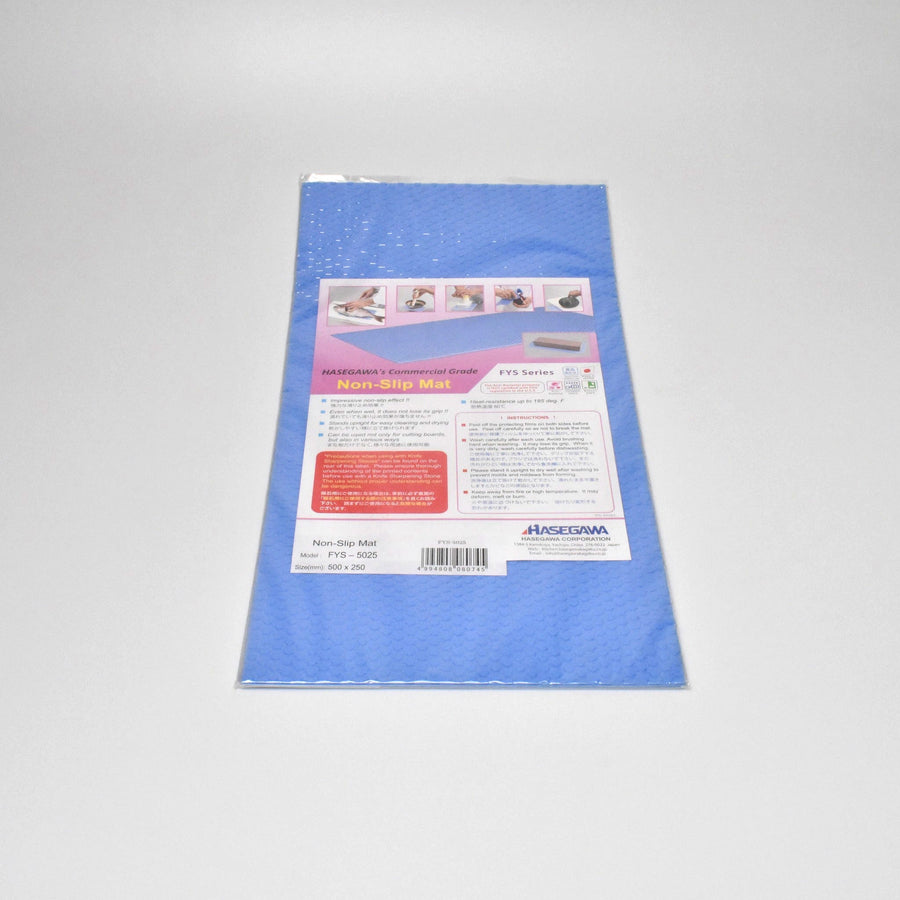
Hasegawa Non-Slip Board Mat
- Sizes
- 25 x 12 / 50 x 25 cm
- Grip
- Both sides, works wet
- Heat
- up to approx. 195 °C
- Care
- Dishwasher safe
Only 2 left in stock
Description
Hasegawa's commercial-grade FYS mat: the board stops moving, full stop.
A cutting board that creeps on a wet steel counter is a safety problem before it is an annoyance. This is the mat Hasegawa makes for its own boards: a grippy silicone-type sheet that locks the board to the counter and the counter to the board, even wet. Heat resistant, dishwasher safe, and it does a second job as a jar-opener and a stabiliser under bowls and hangiri. Two sizes: the small one for under a corner of a board or a mixing bowl, the large one for a full-size professional board.
- 25 x 12 cm - bowls, small boards, jar opening
- 50 x 25 cm - full-size professional cutting boards
- Heat resistance: up to approx. 195 °C
- Care: Wash with detergent, dishwasher safe, air dry
- Pairs with: Hasegawa cutting boards and our Parker Asahi boards
Make it last.
- Rinse under cold water and scrub along the grain with a soft brush after each use
- Stand vertically to dry - never flat, never overnight in a sink
- Don't use soap - it strips the natural antibacterial oils hinoki is prized for
- Never dishwasher - one cycle and the wood splits
- Plane the surface flat when it warps; sand 220 then 400 to refresh stains
Before you buy.
Why hinoki and not maple / walnut?
Hinoki (Japanese cypress) is the traditional sushi-bar board. It's softer than maple, so it gives slightly under the edge - extending the life of the blade. Antibacterial oils in the wood resist mold even in a wet kitchen.
How do I season a new hinoki board?
Soak both sides in cold water for 30 minutes before first use - it stops blood and fat from staining the wood. After every use: rinse under cold water, scrub with a soft brush along the grain, stand vertically to dry. Don't use soap; it strips the natural oils.
Can I put it in the dishwasher?
Never. The heat will split the wood within one cycle, and the detergent kills the antibacterial properties hinoki is prized for.
What about end-grain vs. flat-grain?
End-grain boards are softer on the edge but heavier and pricier. Flat-grain is what every working sushi bar uses - lighter, easier to clean, easier to plane flat if it warps.
Will it stain?
Hinoki yellows slightly with use - the surface oxidises. To bring it back: plane the surface with a hand plane (a job for a craftsman) or sand with 220-grit and finish with 400.

More from Cutting Boards
View all Sale
Sale

